An LDS Homeschool with a Special Needs Focus

Sunday, September 13, 2015

The Best Way to Stop Negative Behaviors

   
   Single Bound?  Okay, single piece of advice.  
  
   My son was an angel baby.  Since he was so late to sit up, crawl, and walk, it seemed like his babyhood lasted extra long.  He was happy to spin in circles on his bottom and look up at the recessed lighting.  On a long drive to California to see his grandparents, he was content inserting a straw into a plastic drink lid over and over for hours and hours on end.  Looking back I can see that he wasn't developing typically, but at the time I was loving my pudgy little guy who could occupy himself so happily with such simple things.

   But once he could get around, he began to drive me nuts with all these repetitive behaviors: flipping light switches, pushing buttons on the TV and dishwasher, and worst of all, hurting my newborn.  It was all about cause and effect for my son (I'll call him #3).  Hurting his little brother was exactly like flipping a light switch or pushing a button.  But, of course, it was horrible and would earn him an instant timeout.  #3 spent A LOT of time in timeout, and yet he'd come right back out and do it again!  I was beside myself.  My girls had responded well to timeouts and other consequences, so why wasn't it working with #3?

   I call that time after #4 was born "The Dark Days."  My newborn cried all the time, and I had to hold him constantly to keep him safe.  I was powerless to change #3's behavior, and I was realizing something wasn't right.  We took him in for an evaluation, and they diagnosed him shortly after he turned three with pervasive developmental delay with tendencies toward autism.  They accepted him into their special preschool for kids on the spectrum.  His time there two days a week felt like sweet relief.  To not have to be on guard constantly, or disciplining, or cleaning up a disaster made me feel like I might actually survive.  But after only two months they told me that they couldn't have him there anymore because he kept hurting the other kids.  "We can't help your son."  I was devastated.

   Through an amazing set of events, #3 landed a spot in special pilot preschool program for kids on the spectrum.  It was intense ABA with an individual aide in a small classroom setting, and my son made huge strides in his speech and behavior.  He soon progressed enough that he attended a regular preschool class in the morning with his aide and then spent time in his special class in the afternoon.  His teachers were incredible, and I found myself relying on their advice on how to help #3 at home.  And no matter the scenario I'd give them, they'd always give me the same advice: praise him for every positive thing he does, try to prevent the bad, and don't make a big deal out of the negative. 

   I remember asking them about what I should do because #3 kept hurting people in the car, and his amazing teacher Miss Patty looked at me and lovingly (yet trying to hold back her exasperation that she had to say it yet again) said, "Just work on praising him for all the little good things he does, try to prevent the bad by changing where he sits or handing him something to do, and then don't make a big deal out of the bad.  Heap love on the person hurt, but ignore #3."  It finally hit me, the same advice applies to every situation!


   Guess what?  It works!  When I focus on praising him for literally every little thing and on preventing negative behaviors by anticipating them, we have great days.  "I love how quickly you hopped out of bed!"  "How did you get your shirt off so fast?  Do you have superhero powers?"  "Thank you for coming when I called.  You're such a good boy!"   When I am constantly looking for and praising him for the good, I see and get more of it.  I know the situations that trigger trouble, and I try to prevent those situations from happening.  And though it is totally counterintuitive, ignoring the bad works.  You just have to say to yourself, "If I give attention to the negative, I will get more negative, even if those around me will think I'm a bad parent for not getting after my kid."

   Last year, #3 attended 1st Grade at a charter school for kids on the spectrum.  His homeroom teacher never had any trouble with him, but his reading and math teachers were beside themselves.  I decided to visit their classrooms to see what was happening.  His homeroom teacher was praising her students' good behavior just about every other sentence.  "Good sitting on your pockets, Henry!"  "I love how you're keeping your hands to yourself, Asher."  She had a room of kids on the spectrum all behaving properly.  The other teachers were pulling my son aside after negative behaviors and talking to him gently about making good choices.  It was so rewarding that #3 wanted more quiet, face-to-face time with his pretty teachers, so of course his negative behaviors escalated.

   Positive reinforcement is powerful!  It absolutely works.  The tricky part is making it a habit and keeping up on it.  Whenever my son is neck-deep in negative behaviors, I can see that I haven't been praising the good or that I didn't work to prevent.  It is easy to let personal stress, busyness, and negativity seep in.  But I've seen that turning the day around is only just a handful of compliments away.  When mom is in positive-mode, amazing things happen at our house.  Try genuinely praising your kids, spectrum or not, consistently and conscientiously for a couple days and see what happens.

Sunday, September 6, 2015

Motivators for Kids with Autism and ADHD


     If you have a child or student with autism or ADHD, you know how difficult it can be to get them to complete school work.  Many times they are only interested in their current mania.  Don't fight it.  Use it!
    1.  I have my kids choose a reward from the Reward Board.  They place it next to their work so they can remember what they are working for.  Then we set the timer for a reasonable amount of time, and if they finish in that amount of time, they get their reward.  For some kids, this is enough to move them through their work.  My older kids will to two "Need-to-Do's" before they get to do a "Want-to-Do" from the board.  It's a great way of teaching time management.

     2.  My son with autism has serious attention issues and has to be moved from one problem to the next.  Even in his classroom of kids on the spectrum, he monopolized the aide. We just started homeschooling him this year, so I developed ways to motivate him problem-by-problem or line-by-line.
     Since he loves Angry Birds Transformers, I printed out pictures of various characters, cut them out, and laminated them.  As he finishes a problem or row, depending on his ability to focus that day, he grabs a piece of the Transformer from a plastic bag and "builds" it as he does his work.  When the page is done, the Transformer is complete AND he has earned his chosen reward from the Reward Board.  This idea is simple because no matter how his interests change, I can always make new characters to motivate him.  He also gets a kick out of mixing and matching Transformer parts.

     3.  Too keep things fresh, we also use sticker puzzles in the same way.
     4.  If you don't have any stickers on hand or just want to mix things up, you can draw a part of a picture each time a row is completed.
          5.  Both my son and daughter on the spectrum also love a "secret message"on their work. As they finish a problem, I write one of the letters of the message down in random order.

     The great thing about each of these motivators is that they can be adapted easily for the student's attention that day or to their ability to concentrate as it improves over time.  They also make use of the power of the student's mania.  Yes, it is a lot of work to motivate our students with attention issues, but it is much more satisfying and effective to draw a picture or build a mini puzzle than it is to say for the thousandth time, "Come on, next problem!"

Saturday, August 1, 2015

Fridays Short Daily Writing: Gratitude Journals


Gratitude Journal Instructions:
I'm thankful for
1.
2.
3.

In complete sentences, write one good thing that happened this week.

Thursdays Short Daily Writing: Journal Prompts


Choosing a journal prompt and writing as much as one can in a set amount of time is a powerful tool to unlock the imagination and to hone a student's writing skills.  It also lends itself to adaption to ability.  Older students can write for longer periods of time.  Younger or special students may only write a sentence or two to begin with.  Preschoolers can draw pictures.  From the following lists, I typed up prompts I felt would excite my children and placed them in glass jars.  Each Thursday they can pull up to three prompts, but they must choose from one of the three.  The Scholastic Story Starters can used as one of the 3 prompts.


Journal Prompts for Younger or Special Learners
From The Autism Helper

     For my kids on the Autism Spectrum, I am personalizing some of the prompts to be specific to their intense interests.  My daughter will have prompts about becoming various animals, being a character in Harry Potter, and experiencing natural disasters.  My son will write about Angry Birds, Star Wars, Halloween costumes, and robots.
Simple Journal Prompts
Journal Prompts for Little Ones

Friday, July 31, 2015

Wednesdays Short Daily Writing:Grammar


Wednesdays:Grammar
I have a confession.  I love grammar, and I dread teaching it to my kids.  No one wants to hear the groans and to be made to feel like Torturer-in-Chief.  That's why I think doing it for 10-15 minutes every Wednesday morning is perfect.  I taught remedial English to community college freshmen who either were ESL or scored really poorly on the ACT/SAT.  I found that if I kept it straightforward, and left out all the crazy grammar vocabulary, they got it!   My kids range in age and have a variety of special education needs, so I've geared it to (hopefully) work for all of them.  Be sure to remind your students of capitalization and punctuation whenever they write.  For my 7 year old son with Autism, many of the exercises will not be written.  We'll make the corrections together since small amounts of writing overwhelm him.  Here is my outline for teaching basic grammar to competent readers of any age in 36 weeks:

Section 1:Identifying Prepositional Phrases
Why start here?  We start with prepositions because identifying and crossing out prepositional phrases will make it MUCH easier for your students to identify the subject and verb.  And identifying subjects and verbs is critical for correct punctuation.  Here's a List of Prepositions to print out for your student to have on hand to accomplish the following work.

Week 1: Watch this video about Prepositions and write down 15 prepositions
Week 2: Hunting for Prepositions To save time, hide the eggs (or objects of your choice) the night before.
Week 3: Print this Prepositions Worksheet
Week 4: Print this Prepositional Phrases Worksheet
Week 5: Print this Identifying Prepositional Phrases Worksheet
(You want to make sure your kids are REALLY good at this because it will make everything else so much easier! Don't move on until they have it.) Have your kids take this quiz to find out if they've got it.

Section 2:Identifying Subjects and Verbs
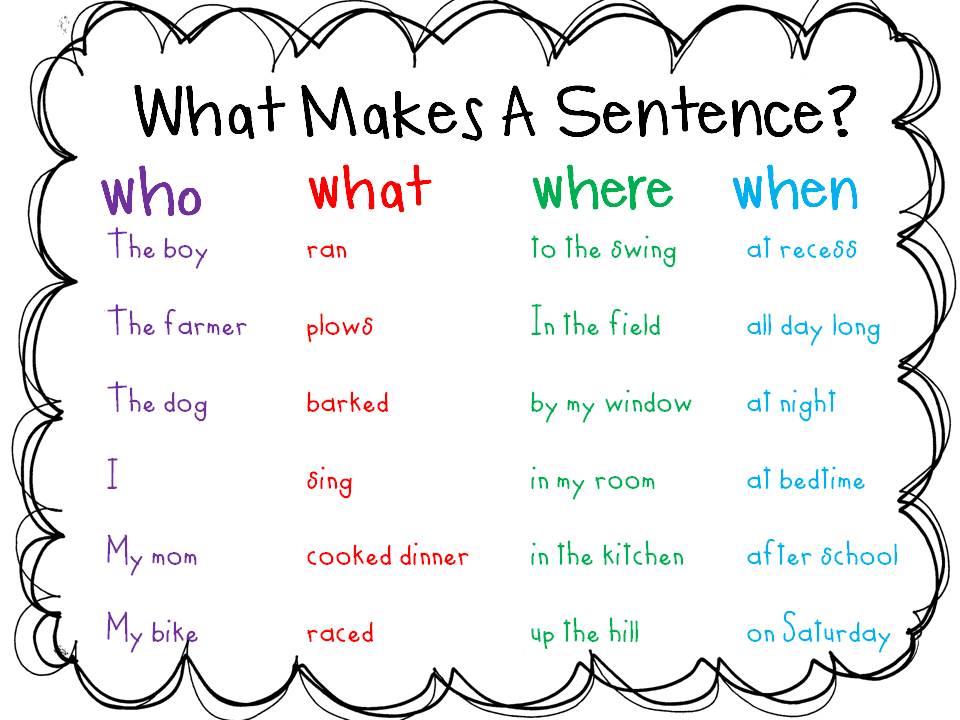
Students need this skill to make sure they are forming sentences correctly.  Each sentence has to have a subject and a verb.  If it doesn't, then it isn't a complete sentence.  Identifying subjects and verbs helps students know how to fix sentence fragments, place end punctuation correctly, and properly use commas.  Don't worry.  We'll get to all of that!  For now, just help your kids to identify subjects and verbs.  Removing prepositional phrases from any sentence will make this much easier, so always have them start there.  Then we work on finding the verb.  Kids are usually pretty good at finding the action word.  Then they just need to ask "Who or what did the action?"  That will help them find the subject quickly.  Many kids can quickly find the subject and verb, and this might seem like a convoluted way of getting there, but this method is really effective for students that struggle with grammar.

Week 6: Identifying Verbs and Nouns (a good short brush up!)
Week 7: Identifying Verbs (Be sure to cross out the prepositional phrases first.)
Week 8: Identifying Linking Verbs
Week 9: Identifying Helping Verbs (Have the students write the verb including the helping verb: "has promised, etc."
Week 10: Subject and Verb Matching Game
Week 11: Identify Subjects
Week 12: Identifying Subjects and Verbs (Tell your students "predicate" is another way to say "verb.")
Week 13: Identifying Subjects and Verbs
Week 14: Complete Sentence?
Week 15: Complete Sentence or Fragment?
Week 16: Complete Sentence or Fragment?
Week 17: Writing Sentences Formula  Have the students formulate 5 sentences and identify the subject, verb, and prepositional phrases.

Section 3: Basic Punctuation--Capitalization, Periods, Question Marks, Exclamation Points, Commas, and Quotations.
Hopefully you been making note anytime your child is writing of basic capitalization and end punctuation rules.  We'll do a short, official review of these subjects before moving on to commas and quotation marks.

Week 18: Capitalization Game Print out these Capitalization Rules to refer to while playing.

Week 19: Play the Capitalization Board Game again.  Can you remember the rules?
Week 20: Ending Punctuation
Week 21: Follow the instructions for the Modeling/Mini-Lesson with this Run-on Sentence
Week 22: Run-on Sentences
(Since I'm trying to provide links to free resources and couldn't find a good one, I thought I'd write up some quick exercises here for run-on sentences.)
Exercise 1
Instructions: Find the 2 complete thoughts in each problem.  Rewrite the thoughts as two separate. sentences.

1. Megan didn't like broccoli she thought it smelled like stinky feet.
2. She also didn't like zucchini it seemed like some weird combination of broccoli and kiwi.
3. Anything green in color appeared suspicious she distrusted anything that color.
4. But something happened that changed her mind it's a long story.

Week 23: Run-on Sentences
Exercise 2
Instructions: Find the 2 complete thoughts in each problem.  Rewrite the thoughts as two separate sentences.

1. Megan was left to babysit her brothers and sisters they were so hungry!
2. She opened the fridge there was nothing but green food.
3. She had no choice she had to cook some broccoli to stop their crying.
4. The baby wouldn't eat any unless Megan took a bite first she faked a smile and put some in her mouth.
5. Megan decided that anything green can be made delicious you just have to smother it in yellow butter first.

Week 24: Fixing Run ons with Commas and F.A.N.B.O.Y.S. 
     We can fix run-on sentences by adding a comma and a conjunction.  For, And, Nor, But, Or, Yet, and So are all conjunctions, but I just call them F.A.N.B.O.Y.S.  Memorize them!  If you only put a comma and not one of the F.A.N.B.O.Y.S. between two complete thoughts, it's called a comma splice and is a big No-No! Try fixing the sentences about Megan by adding a comma and a F.A.N.B.O.Y.S
Exercise 1
Instructions: Connect the two thoughts with a comma and one of the F.A.N.B.O.Y.S.  Your student may want to use the word "because" in some of these sentences. They can, but make sure they know that we NEVER put a comma before the word "because." 
Example: Megan was a picky eater she rarely ate her vegetables.
Fix: Megan was a picky eater, so she rarely ate her vegetables.

1. Megan didn't like broccoli she thought it smelled like stinky feet.
2. She also didn't like zucchini it seemed like some weird combination of broccoli and kiwi.
3. Anything green in color appeared suspicious she distrusted anything that color.
4. But something happened that changed her mind it's a long story.

Week 25: Fixing Run ons with Commas and F.A.N.B.O.Y.S. 
Exercise 2
Instructions: Connect the two thoughts with a comma and one of the F.A.N.B.O.Y.S.  
Example: Megan was a picky eater she rarely ate her vegetables.
Fix: Megan was a picky eater, so she rarely ate her vegetables.

1. Megan was left to babysit her brothers and sisters they were so hungry!
2. She opened the fridge there was nothing but green food.
3. She had no choice she had to cook some broccoli to stop their crying.
4. The baby wouldn't eat any unless Megan took a bite first she faked a smile and put some in her mouth.
5. Megan decided that anything green can be made delicious you just have to smother it in yellow butter first.

Week 26: Joining Words (Subordinating Conjunctions) and Commas

Words like after, although, as, because, before, how, if, once, since, than, that, though, till, until, when, where, whether, while might be the perfect way to fix a run-on sentence.  For example, "Megan didn't like broccoli because she thought it smelled like stinky feet."  If any of the above words is in the middle of a sentence, do not put a comma in front.  If it comes at the beginning of a sentence, put a comma after the thought. Example: "Because she thought it smelled like stinky feet, Megan didn't like broccoli."

Exercise: Place the commas in any sentence that needs one.
1. I really want to go to the zoo because they have a baby giraffe.
2. Because the baby is so small they are keeping her and her mother in a special place.
3. If we go to the zoo we need to make sure we bring some money.
4. I'm planning on buying a toy giraffe so I can play with it at home.

Week 27: More Joining Words and Comma Practice (Do at least 1-5)
Week 28: Commas in a Series
Week 29: Commas with Non-Essential Info (Do Section 4)
Week 30: Commas and Quotation Marks (Do Section 5)
Week 31: Commas and Introductory Elements (Do Section 6)
Week 32: Commas and Places (Do Section 7)
Week 33: Commas and Dates (Do Section 8)
Week 34: Contractions Match Game
Week 35: Comma Chameleon Game
Week 36: Review

Exercise:
Fix any problems in the following sentences:
1. my dad loves ice cream brownies and cobbler
2. if your dad ate everything at once do you think he'd get sick
3. it makes me sick just thinking about it, because i ate too much at the party
4. i'm hoping for pumpkin cookie I could eat a pile of them
5. empty promise


Monday, July 20, 2015

Tuesdays Short Daily Writing:Poetry


Tuesdays: Poetry

Week 1: Autobiographical Poem (I loved doing this one with my high school students to get to know them!)
Write a poem about yourself using this form.
Line 1:_____ (your name)
Line 2:_____,_____,_____ (3 personal characteristics or physical traits)
Line 3:Son/Daughter of _____ (list parents)
Line 4:Who loves _____,_____,_____ (3 people, places, things, or ideas)
Line 5:Who feels _____ about _____ (emotion about one thing)
Line 6:Who needs_____, _____, _____ (list 3 things you need)
Line 7:Who gives _____,_____,_____ (list 3 things you share)
Line 8:Who fears _____,_____,_____(list 3 things you fear)
Line 9:Who'd like to see _____ (1 person or place)
Line 10:Who dreams of _____ (1 thing you dream)
Line 11: Future _____ (1 job or occupation you think you'd like)
Line 12:_____ (Nickname)
     
Week 2:Color Poem
Week 4:Haiku-What Am I?  (Practice by identifying the animals in these Haikus.)
Week 5:Limerick
Week 6:Quatrains (A-B-A-B rhyming pattern, 4 lines)
Week 9:Funny Epitaph Poem (Good for around Halloween!)
Week 10:Clerihew Poem
Week 11:Concrete Poem
Week 15:Portrait Poem (Portrait Poem #2, 1st Stanza)
Week 18:Haiku
Week 19:Limerick
Week 20:Quatrain (A-A-B-B rhyming pattern, 4 lines)
Week 22:Portrait Poem (Portrait Poem #2, 2nd Stanza)
Week 23:Never Poem
Week 25:Book Spine Poetry (You'll want lots of kids picture books on hand) 
Week 26:Cinquain
Week 27:Tanka Poem
Week 28:Elizabeth Barret Browning: How Do I Love Thee?
Week 29:Portrait Poem (Portrait Poem #2, 3rd Stanza)
Week 30:Apology Poem

Sunday, July 19, 2015

Monday Short Daily Writing: Book of Mormon Scripture Mastery


We have been doing a daily gratitude journal first thing every day since we started homeschool.  The last couple months of school this year, the gratitude journals were getting stale and repetitive, so I wanted to change things up to tackle several different types of writing.  I wanted to develop short daily writing assignments to keep things fresh and develop writing skills.  We do longer writing assignments, paragraphs and essays, as a part of our History, Reading, or Science lessons, but with these lessons, the kids are doing 10-15 minutes of writing a day.

Mondays: Scripture Mastery Copy Work

     *Copy the week's scripture mastery verse.
       Small or special kids can do the key words.


Tips:
     *Use the verses for dictation, copy work, or penmanship
     *Repeat the scriptures out loud together (march, sing, dance, jump, basically make it fun.)
     *Have them underline or mark it in their scriptures
     *Watch and Sing with These Articles of Faith Videos 
     *Play The Articles of Faith Memory Quest

     *Print Articles of Faith Flashcards from All Things Bright and Beautiful (above)

     *Display Framed Prints of the Articles of Faith by Simply Fresh Designs (above)
     *Use the scriptures in Family Home Evening
     *Use LDS Scripture Mastery App
     *Learn these Scripture Mastery Songs
     *Try a few Scripture Mastery Games

     *Print and Display theseScripture Mastery Posters from Mormon Share (above)

Here is the schedule we'll follow:

Week 1: Article of Faith 1-2

Week 2: Article of Faith 3-4
Week 3: Article of Faith 5
Week 4: Article of Faith 6
Week 5: Article of Faith 7
Week 6: Article of Faith 8
Week 7: Article of Faith 9
Week 8: Article of Faith 10
Week 9: Article of Faith 11
Week 10: Article of Faith 12
Week 11: Article of Faith 13
Week 12: 1 Nephi 3:7
Week 13: 2 Nephi 2:25
Week 14: 2 Nephi 2:27
Week 15: 2 Nephi 9:28-29
Week 16: 2 Nephi 25:23, 26
Week 17: 2 Nephi 28:7-9
Week 18: 2 Nephi 31:19-20
Week 19: 2 Nephi 32:3
Week 20: 2 Nephi 32:8-9
Week 21: Mosiah 2:17
Week 22: Mosiah 3:19
Week 23: Mosiah 4:30
Week 24: Alma 7:11-13
Week 25: Alma 32:21
Week 26: Alma 37:35
Week 27: Alma 39:9
Week 28: Alma 41:10
Week 29: Helaman 5:12
Week 30: 3 Nephi 12:48
Week 31: 3 Nephi 18:15,20-21
Week 32: Ether 12:6
Week 33: Ether 12:27
Week 34: Moroni 7:41
Week 35: Moroni 7:45, 47-48
Week 36: Moroni 10:4-5